
Course Details
Your Growth, Our Mission
Course Description
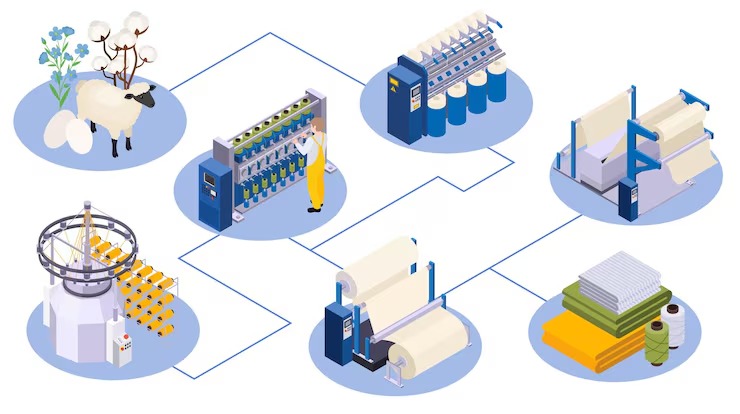
This course provides an overview of textile materials, manufacturing processes, and testing practices. It covers fibers, yarns, and fabric formation technologies, including weaving, knitting, and non-woven systems, with an emphasis on performance and applications. Textile pre-treatment, dyeing, printing, and finishing processes are discussed from the perspectives of product quality and functionality. The course also addresses sustainability drivers, regulatory considerations, and emerging material solutions. A strong emphasis is placed on standards, testing methodologies, and quality control to ensure reliable product performance and compliance.
The Training Course Will Highlight ?
Training Objective
By the end of this course, participants will be able to:
· Understand the classification, structure, and properties of natural, synthetic, and technical textile fibres.
· Explain yarn and fabric manufacturing processes, including weaving, knitting, and non-woven technologies.
· Relate textile structure and processing routes to performance characteristics and end- use applications.
· Understand textile wet processing operations such as pre-treatment, dyeing, printing, and finishing.
· Apply standard textile testing methods to assess physical, mechanical, colour fastness, and functional performance.
· Interpret relevant textile standards (ASTM, ISO, EN) and quality control requirements.
· Recognise sustainability challenges, regulatory drivers, and emerging material solutions within the textile industry.
Target Audience
This course is intended for:
· Engineers, technologists, and professionals working in textiles, high-tech coated fabrics, polymers, composites, or related manufacturing sectors.
· Quality assurance, production, R&D, and product development personnel.
· Graduate students and early-career researchers in textile engineering, materials science, polymer science, or chemical engineering.
· Professionals seeking a structured understanding of textile materials, processing, testing, and sustainability considerations.
Training Methods
The course will be delivered using a blended learning approach, including:
· Presentations and Demonstrations introducing fundamental concepts and industrial practices.
· Case studies illustrating real-world textile applications and quality challenges.
· Standards-based discussions focusing on ASTM, ISO, and EN testing protocols.
· Interactive sessions on material selection, troubleshooting, and performance evaluation.
This approach ensures a strong balance between theoretical understanding and real- world, industry-relevant skills.
Daily Agenda
1. Fibres
· Historical Information
· Introduction to Fibres
· Worldwide Fibre Production, Consumption and Demand
· Fibre Terms and their Definitions
· Classification of Fibres and their properties
o Natural Fibres
o Synthetic Fibres
o Protein Fibres
o Bast Fibres
o Specialty Fibres
· Properties of Fibres
· Fibre Production Processes
o Melt Spinning
o Dry Spinning
o Wet Spinning
· Properties and Applications of Various Synthetic Fibres
· Trade Names of Some Fibres
· Uses of Fibres in Various Applications
2. Introduction to Yarns
· Textile Terms and Definitions
· What Do We Need to Know?
· Why Do We Need to Be Able to Identify Yarns?
· What Do We Expect Yarns to Be Able to Do?
· Classification of Yarns
· Yarn Variables
· Yarn Manufacture General Principles
· Yarn Spinning
· Yarn Types and Their Applications
3. Non-Woven Fabrics
· Definition and Key Functions of Non-Woven Fabrics
· Categories of Non-Woven Fabrics
· Manufacturing Systems
· End-Use/ Applications of Non-Wovens
· 2019 Single Use Plastics Directives (SUPD) and Potential Solutions
o Bioplastics in Non-Woven Fabrics
o Natural Fibres in Non-Woven Fabrics
o Mechanical Recycling
o Chemical Recycling
4. Warp and Weft Knitting
· The knitted Loop
· V-Bed Knitting Machines
· Fabric Structure and Properties
· Other Weft Knitting Machines
· Warp Knit
5. The Weaving Process
· Yarn Numbering System
· Winding
· Warp Preparation
· Principles of Weaving
· Woven Fabric Structures
· Woven Fabric Properties
· 3D Weaving
· Classification of 3D Weaving
6. Textile Pre-Treatment, Dyeing, Printing and Finishing
· Colour
· Fibre Types
· Chemistry of Dyeing
· Printing
· Finishing
7. Standards and Testing
· Importance of Quality
· Why Do We Test?
· Product Quality Control
· Factors Affecting Quality
· Fabric Testing Requirements
· What Do We Test?
· At What Point Do We Test?
· Raw Material Selection
· Physical Parameters of a Textile
· Color Fastness Parameters of a Textile
· Aesthetic Properties
· Functional Properties
· Product Performance- Testing
· Grading
· Standards
· Who Does the Testing
· Legal Requirements
· Product Labelling
Accreditation
BTS attendance certificate will be issued to all attendees completing minimum of 80% of the total course duration.
Quick Enquiry
Request Info
Course Rounds
5 Days| Code | Date | Venue | Fees | Action |
|---|---|---|---|---|
| LAB186-03 |
2026-12-06
|
Dubai
|
USD
5450
|
Register |
Prices don't include VAT
Related Courses
Your Growth, Our Mission
Contact Us
Contact us to meet all your inquiries and needs, as our professional team is pleased to provide immediate support and advice to ensure you achieve your goals and facilitate your experience with us in the best possible way. UAE
UAE
 Office
Mobile
Office
Mobile
 E-mail
 Working
Hours
Working
Hours