
Course Details
Your Growth, Our Mission
Course Description
This course provides project leaders and Managers with the tools and techniques needed to identify, assess, and mitigate risks throughout the lifecycle of a project. By understanding both the theory and practice of risk management, participants will be equipped to address challenges proactively, ensuring projects stay on track and deliver their intended outcomes.
The Training Course Will Highlight ?
Training Objective
By the end of this training course, participants should be able to:
- Create a comprehensive risk management plan (RMP)
- Develop and maintain a detailed risk register
- Analyze risks using qualitative and quantitative methods
- Identify, assess, and apply risk response strategies
- Make informed decisions under uncertainty
- Understand the psychological factors influencing decision-making
- Monitor and control risks throughout the project lifecycle
- Identify emerging risks and respond effectively
- Manage change and its impact on the project
- Develop resilience under work pressure and challenging circumstances
Target Audience
This course is designed for project leaders and professionals responsible for managing risks within their organizations. It is ideal for:
- Project Managers
- Team Leaders and Supervisors
- HSE Managers and Professionals
- Risk Managers
- Health & Safety Officers
- Security and Emergency Response Teams
- Facility Managers
- Plant Managers and Supervisors
- Line Managers and Coordinators
Training Methods
- The course will be delivered through a combination of theoretical lessons and practical exercises, with real-world examples from various industries. It will include case studies, group discussions, role-playing, and risk simulation activities. This approach will ensure that participants not only learn the principles but also know how to apply them effectively in their own projects.
- From a project management perspective, this course will explain approaches form a wide range – from predictive way to Agile and hybrid ones.
Daily Agenda
Module One:
Introduction to Risk Management
- Welcome participants
- Overview of Risk Management: Define what risk management is, why it’s important, and the consequences of ignoring risks in projects.
- Risk Management Process: Break down the process into steps—Risk Identification, Assessment, Response, and Monitoring.
- Risk Culture: Discuss how building a risk-aware culture within a team or organization can help manage risks more proactively.
- Risk Management Standards: Introduce ISO 31000 or PMI’s PMBOK® Guide for structured approaches to risk management.
Module Two:
Risk Identification and Assessment
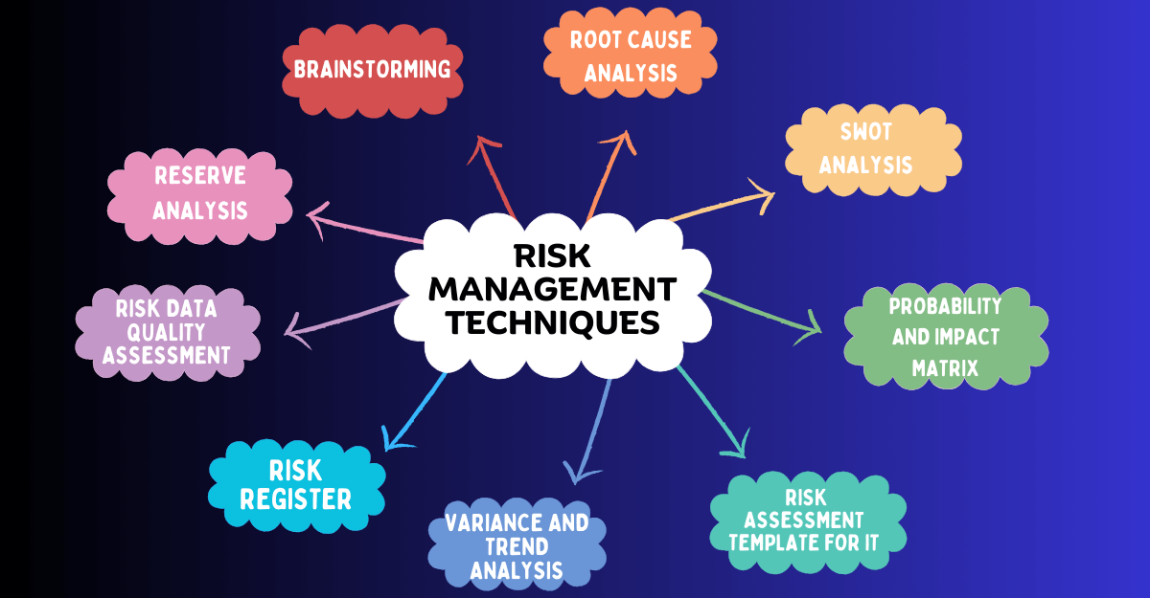
- Techniques for Identifying Risks: Use tools like risk checklists, expert judgment, brainstorming sessions, and historical data.
- Risk Categorization: Explore different risk categories (e.g., financial, technical, environmental) and how they affect project outcomes.
- SWOT Analysis: Use SWOT (Strengths, Weaknesses, Opportunities, Threats) to identify risks in both internal and external environments.
- Risk Prioritization: Discuss how to prioritize risks based on their likelihood and impact (using tools like the Risk Matrix).
- Initial Risk Register: How to create a basic risk register for documenting and tracking identified risks.
Module Three: Qualitative and Quantitative Risk Analysis
Qualitative Analysis:
- Probability and Impact Matrix: How to rank risks based on their probability of occurrence and their potential impact.
- Risk Rating: How to assign qualitative ratings (e.g., high, medium, low) to assess risk severity.
Quantitative Analysis:
- Expected Monetary Value (EMV): Introduce EMV as a decision-making tool for analyzing financial risks, where EMV = (Probability × Impact).
- Decision Trees: Explain decision trees for evaluating different risk options and choosing the best course of action.
- Sensitivity Analysis: Introduce sensitivity analysis to understand how changes in assumptions affect project outcomes.
- Monte Carlo (Optional)
Module Four: Risk Response Strategies and Contingency Planning
- Risk Response Strategies:
- Avoidance, Mitigation, Transfer, and Acceptance: Explore strategies for responding to identified risks and examples for each.
- Developing Contingency Plans: Define contingency planning and how it relates to minimizing risk impact.
- Risk Sharing and Transfer: Discuss how risk can be shared (e.g., outsourcing) or transferred (e.g., insurance).
- Implementing Response Plans: Develop action plans for addressing the most critical risks and assigning roles.
- Contingency Reserve: Discuss how to set aside contingency funds and time buffers in project planning to address unforeseen risks.
Module Five: Monitoring, Controlling, and Managing Change
Monitoring and Controlling Risks:
- Risk Audits and Reviews: Introduce risk audits to regularly review risk mitigation progress.
- Tracking Risks and Changes: How to track emerging risks and update the risk register throughout the project lifecycle.
- Change Control Process: Define the change control process and its role in managing risk-driven changes.
Handling Project Stress: Provide techniques for managing stress, maintaining focus, and ensuring productivity in the face of risk.
Conflict Management: Explain methods for managing conflicts that arise from risk-related challenges, such as negotiation and problem-solving.
Feedback
Course end.
Accreditation
-
BTS attendance certificate will be issued to all attendees completing minimum of 80% of the total course duration.
Quick Enquiry
Request Info
Related Courses
Your Growth, Our Mission
Contact Us
Contact us to meet all your inquiries and needs, as our professional team is pleased to provide immediate support and advice to ensure you achieve your goals and facilitate your experience with us in the best possible way. UAE
UAE
 Office
Mobile
Office
Mobile
 E-mail
 Working
Hours
Working
Hours