

Course Details
Your Growth, Our Mission
Course Description
Seismic geophysics represents a fundamental tool for both the exploration and development of hydrocarbon resources. This course provides the fundamentals and the practical application of seismic principles, including aspects of acquisition, processing, and interpretation. Primary emphasis is toward interpretation aspects and workflow.
Key topics include survey design for maximizing interpretational goals such as multicomponent and azimuthal surveys, processing techniques including prestack versus poststack migration, visualization and presentation techniques, general 2D/3D/4D interpretational techniques and principles including various pitfalls of seismic interpretation, integration of seismic data and other datasets (especially well data), and attribute and AVO/AVA analyses.
The Training Course Will Highlight ?
The course is designed from an applied standpoint for geophysicists, with numerous case studies serving to provide critical insight into the use of seismic data in early exploration efforts through later development and reservoir characterization phases. Multiple exercises are used to provide important hands-on learning.
Please note:
Participants must provide their own laptops for this course.
Training Objective
- Achieve an understanding of seismic wave types and propagation, and elastic properties.
- Achieve an understanding of seismic acquisition fundamentals and new technologies.
- Achieve an understanding of seismic processing fundamentals and new methods.
- Achieve an understanding of seismic interpretation fundamentals and modern techniques.
- Achieve and understanding of basics of seismic attributes, AVO/AVA, and inversion.
Target Audience
Geoscientists, engineers, team leaders, geoscience technicians, asset managers, and anyone involved in using seismic data needs to understand and use this data at a basic level or to communicate with others that use it
Training Methods
This interactive Training will be highly interactive, with opportunities to advance your opinions and ideas and will include;
- Lectures
- Workshop & Work Presentation
- Case Studies and Practical Exercise
- Videos and General Discussions
Daily Agenda
- Introduction to Seismic Geophysics: the need for seismic interpretation and reservoir analysis, with worldwide case examples illustrating their importance to hydrocarbon production and development.
- Seismic Reflection Surveying – general principals of reflection surveying from acquisition, processing, and interpretation including 2D versus 3D versus time-lapse (4D), survey design and optimization, and other principles such as wavelength and resolution, primary versus multicomponent surveys, p-wave versus s-wave surveys (and multicomponet data), amplitude preservation, migration, binning, zero-phase versus phased data (and recognition of), wavelet extraction, inverse modeling, etc.
- Seismic Interpretation Principles – discussion and application of various interpretation techniques and principles as applied to exploration and reservoir characterization, including concepts of structural interpretation (lines/cross-lines, arbitration [user-defined] lines, time slices, visualization techniques, user-tracking versus auto-tracking, etc.), and stratigraphic interpretation (sequence stratigraphy, appearance of key stratigraphic features, texture mapping, etc.). A detailed discussion of display concepts and interpretation procedures/options will be discussed.
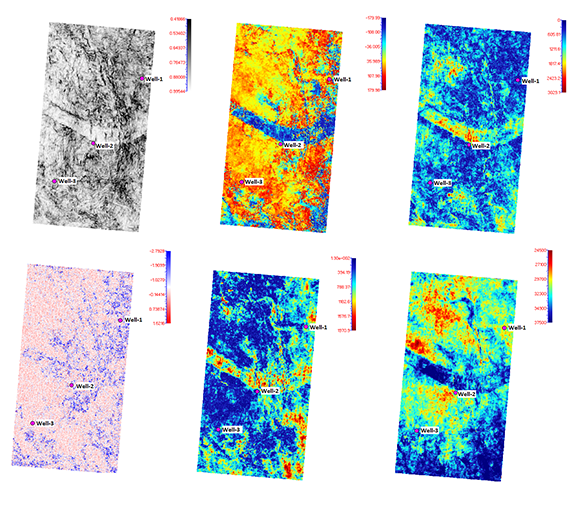
- Seismic Attribute Analysis – the fundamental concepts of seismic attributes, including amplitude, phase, and frequency derived attributes, as well as AVA (amplitude versus angle); additional emphasis on specific attributes as related to structure (e.g., coherence, dip displays, derivative, etc.), stratigraphy (horizon slices and windows, amplitude and other attribute extractions, etc.), and reservoir (see below); and shear-wave anisotropy.
- Reservoir Identification and Evaluation – fundamental concepts of reservoir characterization, including attribute analysis and hydrocarbon indicators, fluid analysis, defining reservoir limits, porosity evaluation, net pay, etc.
- Seismic Petrophysics and Data Integration – concepts including extraction of petrophysical information from seismic data, and the integration of well log (including well bore geophysics) and geological analyses to develop coherent reservoir models.
- Case Histories of Seismic Exploration and Reservoir Evaluation – a detailed examination of worldwide case examples of seismic analysis of hydrocarbon reservoirs.
- Emerging and Alternative Technologies – a look at the future of seismic geophysics and reservoir characterization, including for example reservoir listening techniques.
Accreditation
BTS attendance certificate will be issued to all attendees completing minimum of 80% of the total course duration.
Quick Enquiry
Request Info
Related Courses
Your Growth, Our Mission
Contact Us
Contact us to meet all your inquiries and needs, as our professional team is pleased to provide immediate support and advice to ensure you achieve your goals and facilitate your experience with us in the best possible way. UAE
UAE
 Office
Mobile
Office
Mobile
 E-mail
 Working
Hours
Working
Hours